Roots and Ruins: On George Kalogeris’s Winthropos

by Dominick Knowles

In “Church Bells Will Signal,” the Greek poet and revolutionary Yiannis Ritsos mourns and celebrates the oppressed and martyred during the fight for a liberated Greece: “those ones are in irons, and those others are in the earth. // The earth is theirs and ours.” Although not a “political” poet in the conventional sense, Ritsos helped reclaim the totality of Greek history in service of social struggle, imbuing even his most innocuous lyrics with the specter of solidarity––a subversive practice that got his work banned several times by Greek authorities.

George Kalogeris is also not a “political” poet, but, like Ritsos, his attention to poetic speech emerges from a place of deep struggle and historical memory. His 2018 collection, Guide to Greece, borrows its title from the 2nd-century AD travelogue by Pausanias and charts the intersections of ancient and modern Greece. The decision to poeticize Greece, of course, has a long and uneven legacy in western thought. In the works of non-Greek writers like Michel Foucault, W.B. Yeats, and Robert Penn Warren, their investigations into the ancient world serve mostly to enrich or supplement their own philosophical-poetic development. For many of these writers, “Greece” loses all historical specificity, becoming a metonym for the “west” in its infancy. Greek myths, political forms, and cultural practices are instrumentalized indiscriminately; they gain meaning largely as the foundation of Euro-American culture. Reading, Foucault’s late engagements with ancient Greek poetry, one might not realize that Greece’s history continued past the fourth century B.C.

Continue reading “Roots and Ruins: On George Kalogeris’s Winthropos”
The Novel in the Age of Amazon and the Commercialization of Culture

by Jing Huang

Does a free-market foster or undermine our creativity? How does the market impact cultural creations? Recall this Book’s recent episode made me think of these questions. In the episode, Mark McGurl, the Albert L. Guérard Professor of Literature at Stanford University (Everything and Less: The Novel in the Age of Amazon) discussed how Amazon’s commitment to customer service influences the book industry and the production of literature. McGurl studies Amazon as a social-historical phenomenon that epitomizes the logic of the service economy. McGurl introduces Amazon’s history of bookselling, Jeffrey Bezos’ affinity with books, the company’s literary culture, and its approach to literature, which turns fiction into a form of customer service. McGurl uses a multi-scalar framework that delineates how phenomena are constituted in different institutional environments at various levels of analysis. This allows him to show how Amazon’s success, along with its influence on publishing and literary history, is embedded in a broader background related to the rise of the service economy in the past several decades. McGurl names such background “the age of Amazon.”

Continue reading “The Novel in the Age of Amazon and the Commercialization of Culture”

Another Perspective on Non-Human Minds

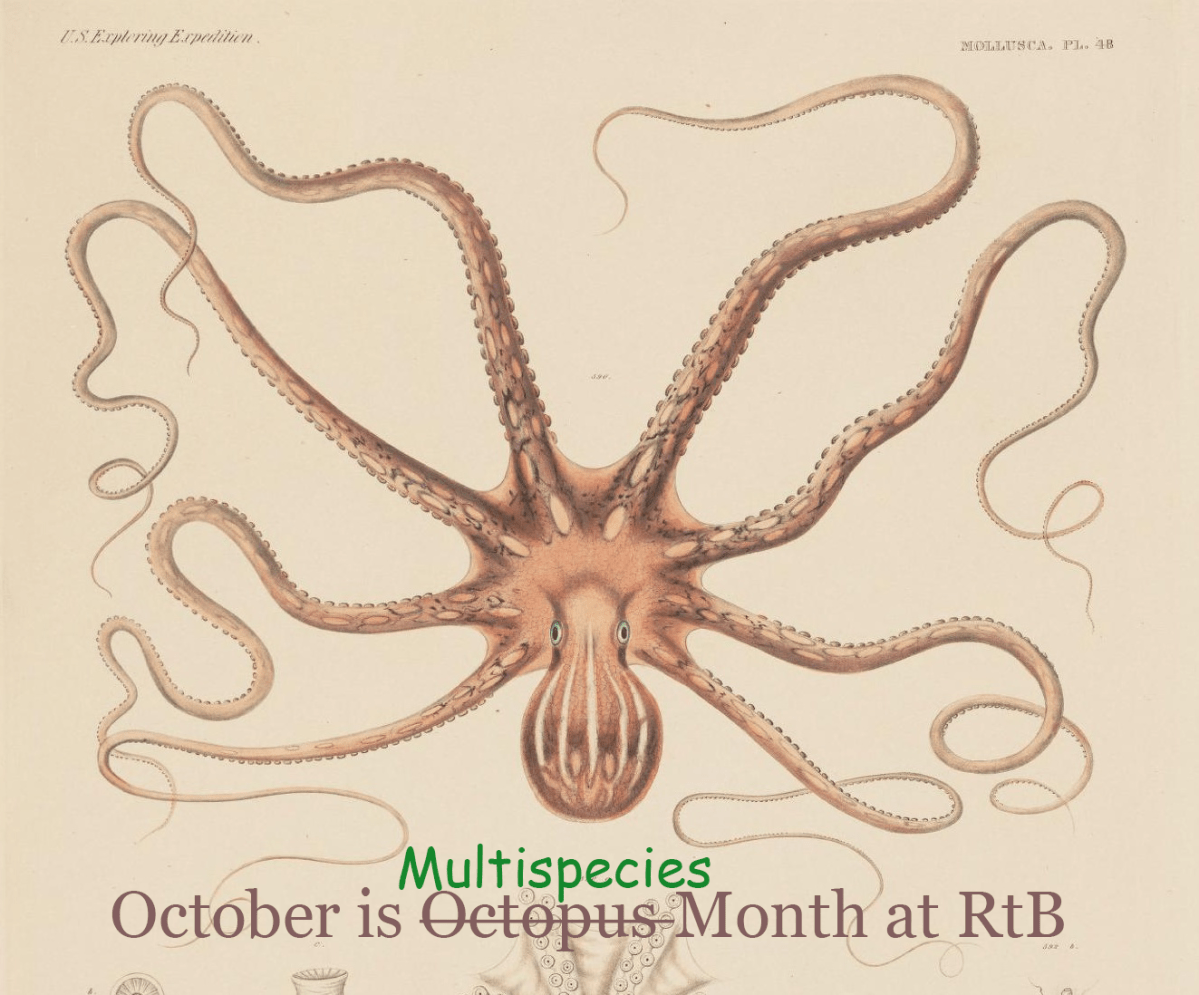
While listening to Peter Godfrey-Smith discuss octopuses on this month’s Recall This Book podcast, I thought of my time with orphaned chimpanzees in Cameroon from 2013 to 2019. For Other Minds, Godfrey-Smith went in search of encounters with nonhuman minds that were “as different as…we can find on Earth” and landed on cephalopods. In my anthropological research, I have been focused on encounters with nonhumans that are shockingly similar to us—chimpanzees.

My work in primate sanctuaries in Cameroon explores interspecies care and what happens when humans try to help orphaned chimps become chimps. In a 2018 post for Sapiens, reposted below, I wrote about how our overwhelming similarities make it difficult for humans to know how to care for chimpanzees. As I reread my essay, I ask myself if there is anything to be gained by thinking of chimps as aliens. By likening octopuses to intelligent aliens, Peter Godfrey-Smith gave readers an opening to the magnitude of interspecies difference that lay between us. He brought octopuses, in all their difference, closer. Could I use the same idea to hold chimps and humans apart? Would thinking of chimps as aliens have helped me see more of our interspecies difference? What might doing so show us about them and their lives?

At a sanctuary in Cameroon, caregiver Henriette holds Gnala, a 2-year-old chimpanzee who had previously lived in a human household as a pet. Amy Hanes/Sanaga-Yong Chimpanzee Rescue

For Chimps, Human Touch Can Hurt

By Amy Hanes

The bruise on my bicep was starting to purple. Small, teeth-shaped scabs crusted over its center. While typing field notes, I stopped midsentence to poke the bruise and see if it still hurt. It did.

Continue reading “Another Perspective on Non-Human Minds”

The Return of Sprezzatura: a 16th-Century Perspective on the Brahmin Left

by Miranda Peery

Recall this Book’s recent summer series on the Brahmin Left began with Jacobin’s Matt Karp arguing that “class dealignments” have arisen due to the failure of Left politics to address or understand the needs of the working class. This and subsequent discussions with Jan-Werner Müller (What is Populism?) and Arlie Hochschild (Strangers in Their Own Land) were inspired by Thomas Piketty’s account of the “Brahmin Left,” a highly educated cultural elite now aligned with liberal politics. This group dominates education, media, technology, and most of the cultural landscape, thus leading to what Piketty refers to as “class cleavages” that run the risk of producing a politics of resentment and alienation among what might be called the anti-Brahmin Right.

Continue reading “The Return of Sprezzatura: a 16th-Century Perspective on the Brahmin Left”