

Why is that when a loved one dies, grief seems inescapable–and then diminishes? The brilliant Edinburgh philosopher Berislav Marusic‘s “Do Reasons Expire? An Essay on Grief” begins with his grief for the unexpected and early loss of his mother: “I stopped grieving or at least the grief diminished, yet the reason didn’t really change. It’s not like that my mother stopped mattering to me or that I stopped loving her, but still this change in grief somehow seemed reasonable.” What are philosophers and the rest of us to make of this durable insight?

John is lucky to be joined in this discussion of Beri’s thoughts on grief by by his new Brandeis philosophy colleague, Katie Elliott. She is not afraid to complicate things further, proposing to Beri that we distinguish between the immediate affective intensity of the initial loss and persistent negative emotions towards the fact of the loss, even when that initial affective heat of loss has faded. Beri reponds that emotions are “thinking with feeling” and we maybe want to be skeptical about splitting the two.
Beri sees two aspects of grief: “On the one hand, the vision of loss that is constituted by grief and on the other hand, a vision of grief from a empirical or as some philosophers, like to say, a creature construction perspective.” It is wrong to make a pragmatist case for the sheerly functional advantages of getting over grief, and also a mistake to see (like Sigmund Freud) grief as a kind of work, a task, to detach oneself from the mourned object.
John asks what it means that he personalizes his sensation of grief, focussing not on the lost beloved, but on the way the beloved, or the lost beloved, remains present to him, a loss felt inside himself. Beri invokes Iris Murdoch’s warning against the “fat relentless ego” (The Sovereignty of Good, 1970, p 50) intruding itself–when what really should be at stake is the lost object of one’s grief. Beri closes by suggesting that grief doesn’t happen to us in the way digestion happens (purely involuntary). Sure, grief is not strictly controllable, and yet because it is reasons responsive rather than simply somatic, it is me.
Mentioned in the Episode
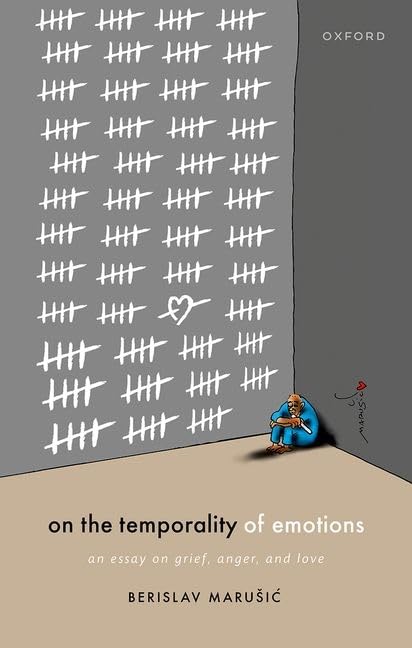
Beri Marusic’s work includes Evidence and Agency: Norms of Belief for Promising and Resolving. (Oxford University Press, 2015) and On the Temporality of Emotions: An Essay on Grief, Anger, and Love.Oxford University Press, 2022.
Jean Paul Sartre’s concept of double vision and of bad faith can be found in Being and Nothingness.
Thomas Nagel View from Nowhere lays out a (Sartrean, says Beri) vision of human experience as necessarily both subjective and objective.
Martha Nussbaum analyzes both grief and anger in Upheavals of Thought: The Intelligence of Emotions. (2012)
The concept of a “creature construction” perspective Beri draws from two sources. Grice, H. Paul. (1974). ‘Method in Philosophical Psychology (From the Banal to the Bizarre).’ Proceedings and Addresses of the American Philosophical Association. Also, Bratman, M. E. (2007) ‘Valuing and the Will,’ In Structures of Agency. New York: OxfordUniversity Press.
Sigmund Freud, Mourning and Melancholia.
Beri describes certain states of mind (the feeling of grief for example, as being “Reasons responsive”; that is they respond to reason and to reasoning (here is an article on the topic).
C S Lewis A Grief Observed
Ashley Atkins, “On grief’s sweet sorrow“
The “Wrath of Achilles” in The Iliad (John loves Emily Wilson’s new version) is impersonal, almost official.
Peter Goldie characterizes emotions as “thinking of with feeling” in The Emotions: A Philosophical Exploration. (2000, 19, 58).
William James on belief: Katie is referring to the argument he makes (against Pascal’s wager as a reasonable basis for belief in God) in an 1896 essay called “The Will to Believe.“
Henri Bergson (who is not a sandwich!) writes about on involuntary memory in Matter and Memory (1896). (Beri’s response: “I don’t have voluntary control over my digestion, but that doesn’t make the digestion deep.”)
Marcel Proust (throughout his Remembrance of Things Past, but most famously with the anecdote of childhood memories triggered by eating a madeline) is interested in involuntary memories precisely because they aren’t under any sort of control.
Recallable Books
Beri: Imre Kertesz Fatelessness (concentration camp memoir)
Katie: J D Salinger “Seymour: an Introduction” (available here if you have a New Yorker subscription)
JP: Mary Shelley, Frankenstein (1818)
Magnetic Fields “I Don’t Want to Get Over You“
Finally, Katie, Beri and John put together a soon-to-be celebrated Spotify playlist of mourning-adjacent songs.
Listen to and Read the episode here.

 Recall This Book