

It is fair to say Aarthi Vadde’s wonderful new book, We The Platform, demonstrates “how literature changes our perspective on the internet.” But you also need to add that it “respond[s] to decline narratives about literature and literary study and offer[s] an alternative to prevailing sense of defeat and nostalgia that guides them.”
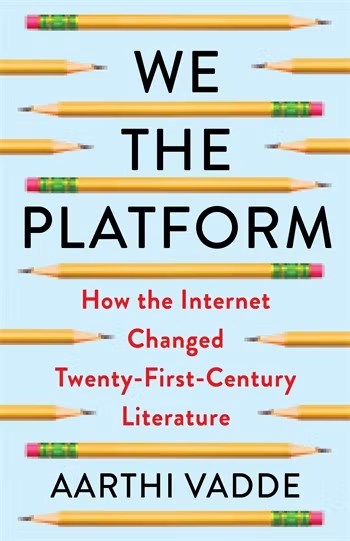
Her conversation with John, like the book itself, aims to narrate the history of Web 2.0 from about 2004 to the present and to explore how writers themselves have responded since 2008. (That means compression” so please Google Aarthi to learn more about her Duke professorship, earlier Levin-prize winning Chimeras of Form: Modernist Internationalism beyond Europe, 1914-2016 , role as President of the Society for Novel Studies; and forthcoming co-edited Columbia University Press collection of conversations from podcast she co-founded, Novel Dialogue.) Aarthi is brimming with unexpected insights about writers responding in varied and unpredictable ways to textual production under digital conditions: Patricia Lockwood, Lauren Oyler, Tao Lin and even Sheila Heti, who early on experimented with LLM conversations in the New Yorker. She sees a new range of writers (Vauhini Vara, Meghan O’Gieblyn) maintaining a commitment to experimental writing, while engaging the power dynamics befalling them with this new tool, what she calls a new case of the “writer’s hand at a distance.”
Finally, when it comes to defining the “multi-front battle” university English departments will have to fight for their survival, Aarthi also wants to respond generously to students whose desire to write is as strong as their desire to read: why should we condemn that as a narcissistic impulse?
Mentioned in the episode
Karen Hao, Empire of AI
Sarah Wynne-Williams, Careless People
Laurence Lessig Free Culture
Xu Bing’s Book from the Ground
Fred Bennison’s Emoji Dick.
Recallable Books
Elizabeth Eisenstein‘s 1970 The Printing Press as an Agent of Change, as well as this AHR debate between Eisenstein and Adrian Johns.
Ben Mangrum, The Comedy of Computation: also this excellent Recall this Book conversation about the feared obsolescence of the human knowledge worker).
Listen to and read the episode here.


