

Distinguished Oxford historian Sudhir Hazareesingh has written a stunning new study documenting the seemingly inevitable resistance that New World enslavement produced throughout its long terrible history. Joining John to speak with Sudhir is George Boulukos of SIU Carbondale, author of The Grateful Slave.
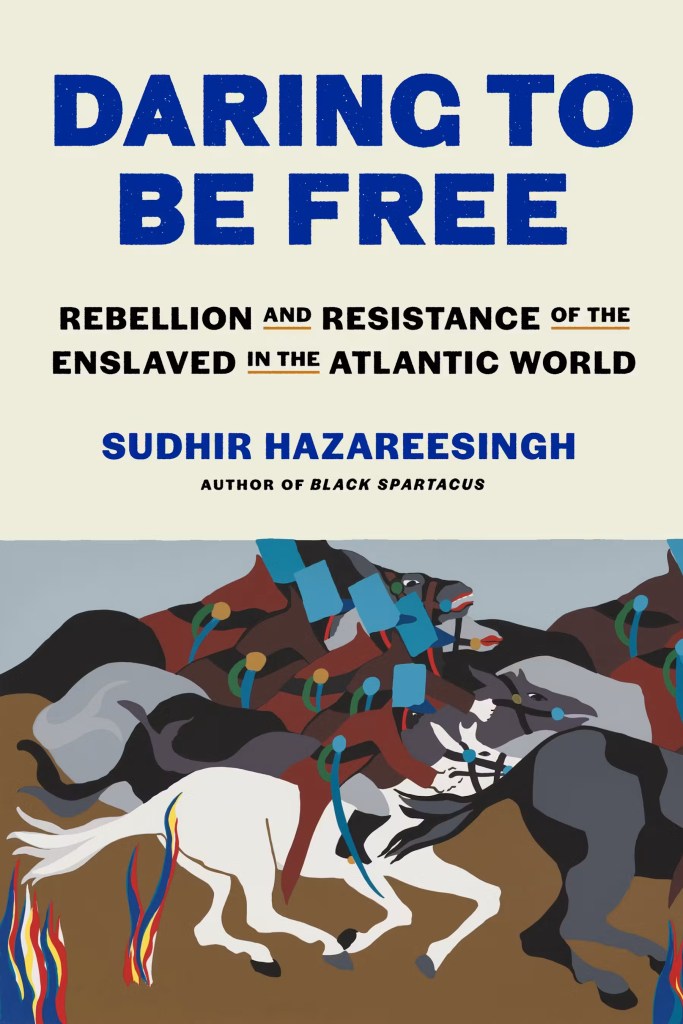
Daring to Be Free Rebellion and Resistance of the Enslaved in the Atlantic World (a suitable companion ot Hazareesingh’s earlier biography of the Haitian nation builder Toussaint Louverture, Black Spartacus). opens up four crucial topics that reshape the stories we tell about slavery’s “social death”. One is persistent resistance during the Middle Passage, another is the omnipresence of successful marronage (meaning escape to highlands or remote refuges). Third is the strikingly omnipresent hope inspired by slaves’ widespread knowledge the successful Haitian revolution. Finally he emphasizes the striking way a sense of agency and autonomy among enslaved persons persisted in the New World–by way both of culture (frequently marked by durable religious practice) and by way of violent, frequently fatal rebellions, which were systematically underacknowledged or swept under the rug within enslaving societies. He sums it up: “resistance during middle passage, marronage, resistance based on culture, insurrections.”
Sudhir persuasively makes the case that the role of benevolent actors within enslaving societies (the William Wilberforces of the world…) “has been greatly exaggerated, and in fact, their interventions were more often than not…actually prompted by the resistance of the enslaved themselves.”
Mentioned in the episode:
Sylvaine Diouf on hinterland marronage, Slavery’s Exiles: The Story of America’s Maroons.
Aime Cesaire, “The Verb ‘Marooner’” (1950, English version 1972)
Francois Mackandal: Haitian religious leader who alluded to and educated Haitians a longer pre-Revolutionary tradition there.
Julis C. Scott, The Common Wind. on communicative structures within the African-American slave world.
Vincent Brown, “Social Death and Political Life in the Study of Slavery.” (2009).
Recallable Books
Rebecca Hall, Wake (graphic novel)
Marcelo D’Salete Angola Janga (Graphic novel about Brazilian Marronage)
C. L. R. James, Black Jacobins (1938)
Richard Price, First Time.
Neil Roberts, Freedom as Marronage (2015)


