175 The Caste Pod: a Crossover episode with Ajantha Subramanian (JP)

In the spirit of Hannah Arendt’s natality principle (that new things are always and should always be being born, each one unique and endowed with limitless potential) we at RTB love it when a new podcast appears. Especially one as thoughtful and original as The Caste Pod, which assembles scholars and activists to make sense of what caste is, how it’s experienced and how it has travelled globally.

Joing us to discuss and share an extended excerpt is its widely published (check out her earlier books!) founder Ajantha Subramanian, Professor of Anthropology at CUNY Graduate Center, and producer (with Lori Allen) of the “Violent Majorities” series here at RTB.
John and Ajantha delve into the founding of the podcast, and then enter into teh business end of the series, which is to explore the complex interplay between caste, race and class as organizing features of economic inequality and its corresponding features of cultural discrimination and oppression.

Ajantha’s extended conversation with Prachi and Ram of Savera, a multiracial, interfaith, anti-caste coalition of Indian Americans from The Caste Pod episode 10 lays bare its premise: to put scholars and activists into conversation and opens a space engineered for each to learn form the other.

Before introducing the Savera excerpt, Ajantha frames the topic by way of Isabel Wilkerson’s influential (if problematic) book Caste and its neglect of class and econoimic issues, and also the case against Cisco for caste discrimination in California that in significant ways internationalized the fight aorund caste’s role in perpetuating economic and political inequity.

Listen and Read Here.

155 Lyndsey Stonebridge on Hannah Arendt’s Lessons on Love and Disobedience (JP)

An Arendt expert has arrived at Arendt-obsessed Recall This Book. Lyndsey Stonebridge discusses her  widely praised 2024 We Are Free to Change the World: Hannah Arendt’s Lessons in Love and Disobedience. Lesley sees both radical evil and the banality of evil at work in Nazi Germany and in the causes of suffering and death in Gaza today. She compares the moral idiocy of authoritarians (like the murderous Nazis and those who are starving Gaza)  to that of philosophers who cannot hear the echoes of what they are doing.

Lesley and John discuss Arendt’s belief in the fragile ethics of the Founding Fathers, with its checks and balances  and its politics based not on emotion but cool deliberation. Arendt could say that “The fundamental contradiction of [America] is political freedom coupled with social slavery,”” but why was she too easy on the legacy of imperial racism in America, missing its settler-colonial logic? Arendt read W. E. B. DuBois (who saw and said this) but perhaps, says Lesley, not attentively enough.

Continue reading “155 Lyndsey Stonebridge on Hannah Arendt’s Lessons on Love and Disobedience (JP)”

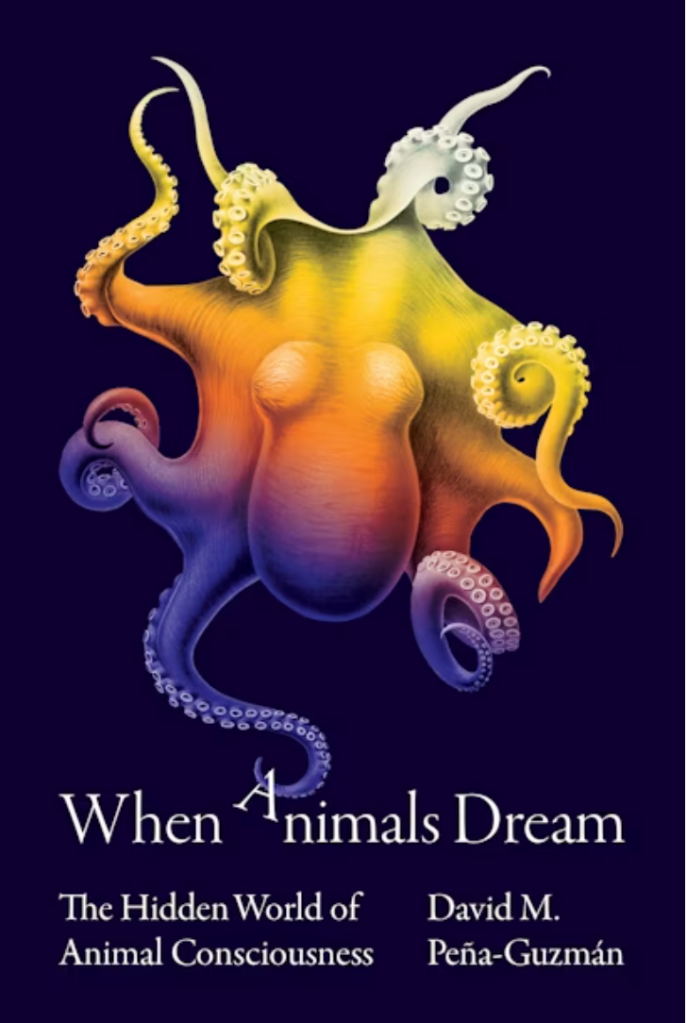
137 David Peña-Guzmán: Animals dream, which makes them morally considerable (JP)

In his marvelous new book, When Animals Dream: The Hidden World of Animal Consciousness, David Peña-Guzmán (SF State as well as the lovely philosophical podcast Overthink) offers up something new in animal studies–“a philosophical interpretation of biological subjectivity.” Although we share no linguistic schema with animals there is lots more evidence than just You Tube (octopuses, dogs, signing chimpanzees, brain scans of dreaming birds etc) to suggest oneiric behaviors and underlying mental states occur all over the animal kingdom. Here is what it means that we are not alone in our dreams…

Continue reading “137 David Peña-Guzmán: Animals dream, which makes them morally considerable (JP)”

10 Life, Writing, and Life Writing with Helena DeBres

Bonus!  Available only on our website,  Episode 10X includes a brief RTB discussion  about Exit Zero, a stunning “auto-ethnography” that raises fascinating questions about what it means when people retell stories or anecdotes about their own lives as a form of evidence that helps explain their overall worldview.

Update: For more on autofiction, check out this essay on Ben Lerner by William Egginton from our partners at Public Books.

How does the past live on within our experience of the present? And how does our decision to speak about or write down our recollections of how things were change our understanding of those memories–how does it change us in the present? Asking those questions brings RTB into the company of memory-obsessed writers like Virginia Woolf and Marcel Proust. But it also takes up into the modern phenomenon of “autofiction,” a term which, if you’ve never heard of before today, you’re in good company! But by discussing autofiction writers like Rachel Cusk, Sheila Heti and Karl Ove Knausgaard, we begin to understand that the line between real-life fact, memory, and fiction is not quite as sharp as we had thought. Continue reading “10 Life, Writing, and Life Writing with Helena DeBres”