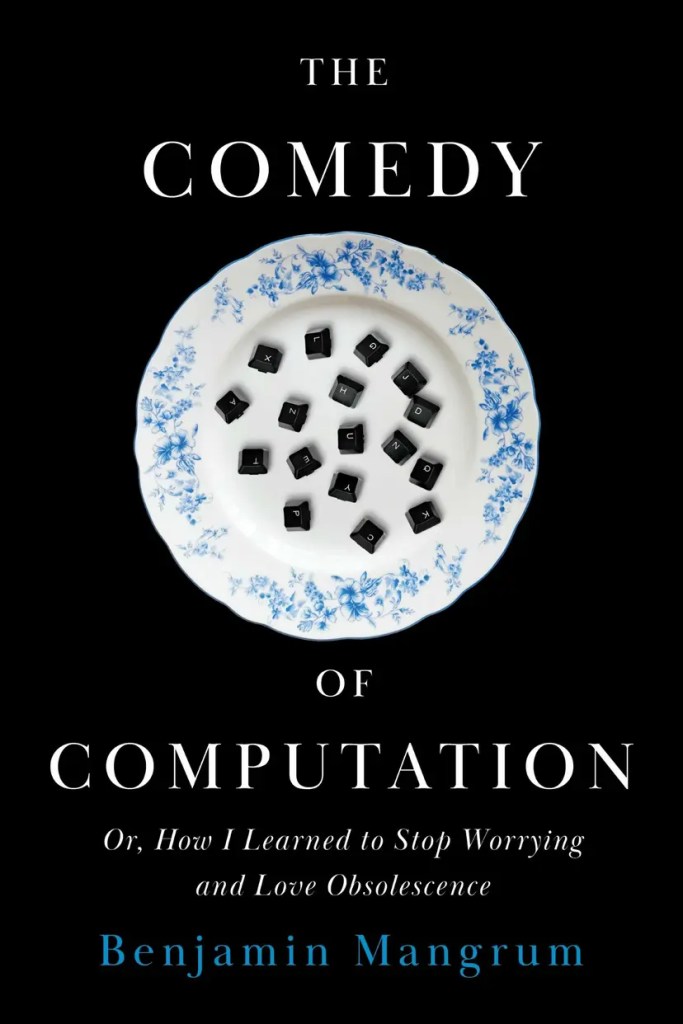
157 Mangrum’s Comical Computation (JP)


When does comedy become more than a laugh? Ben Mangrum of MIT joins RtB to discuss The Comedy of Computation: Or, How I Learned to Stop Worrying and Love Obsolescence, which in some ways is organized around “the intriguing idea that human knowledge work is our definitive feature and yet the machines we are ourselves made are going to replace us at it.” Comedyhas provided a toolbox (Charles Tilly calls them “collective repertoires”) for responding to the looming obsolescence of knowledge workers.
Continue reading “157 Mangrum’s Comical Computation (JP)”

154* Planetary Boundaries are Non-Negotiable: Kim Stanley Robinson (Elizabeth Miller, JP)

With influential series on California, on the terraforming of Mars, and on human civilization as reshaped by rising tides,  Kim Stanley Robinson  has established a conceptual space as dedicated to sustainability as his own beloved Village Homes in Davis, California.

All of that, though, only prepared the ground for The Ministry for the Future, his 2020 vision of a sustained governmental and scientific rethinking of humanity’s fossil-burning, earth-warming ways. Flanked by JP, KSR’s friend and ally Elizabeth Carolyn Miller (celebrated eco-critic and UC Davis professor) asked him to reflect on the book’s impact in this conversation with our sister podcast, Novel Dialogue.

Continue reading “154* Planetary Boundaries are Non-Negotiable: Kim Stanley Robinson (Elizabeth Miller, JP)”

7 In Focus: Samuel Delany in conversation with John Plotz (Nevèrÿon, Triton, Gertrude Stein and more….)

loz_delany_2015

On August 6, 2019, an article based on this podcast interview appeared in our partner publication, Public Books. 

Fresh on the heels of our conversation with Madeline Miller, author of Circe,  John Plotz has a talk with Samuel Delany, living legend of science fiction and fantasy. You probably know him best for breakthrough novels like Dhalgren and Trouble on Triton, which went beyond “New Wave” SF to introduce an intense and utterly idiosyncratic form of theory-rich and avant-garde stylistics to the genre.  Reading him means leaving Earth, but also returning to the heady days when Greenwich Village was as caught up in the arrival of Levi-Strauss and Derrida to America as it was in a gender and sexuality revolution. Continue reading “7 In Focus: Samuel Delany in conversation with John Plotz (Nevèrÿon, Triton, Gertrude Stein and more….)”