

The largest slave uprising in the 18th century British Caribbean was also a node of the global conflict called the Seven Year’s War, though it isn’t usually thought of that way. In the first few days of the quarantine and our current geopolitical and epidemiological shitshow, John and Elizabeth spoke with Vincent Brown, who had recently published Tacky’s Revolt: The Story of an Atlantic Slave War (Belknap, 2019), centered on a group of enslaved West Africans, known under the term “Coromantees” who were the chief protagonists in this war.
Continue reading “129* Vince Brown, Vectors ( EF, JP)”Author: plotznik
I teach English (mainly the novel and Victorian literature) at Brandeis University, and live in Brookline.
128 Recall This Story: Steve McCauley excavates John Cheever’s “The Five-Forty-Eight” (JP)
We debut a new feature: Recall This Story, in which a contemporary writer picks out a bygone story to read and to analyze. Surely there is no better novelist to begin with than RTB’ shouse sage, Steve McCauley.

And not just because he’s got the pipes to power through a whole fantabulous John Cheever story. “The Five-Forty-Eight” (published in The New Yorker 70 years ago) is about sordidness uncovered, a train, and a face in the dirt. It ticks almost every Cheever box, evoking an infinitude of lives unled elsewhere while ostensibly documenting nothing more than the time to takes to down a couple of drinks, scuttle feverishly through some midtown streets, and take a lumbering commuter train out of the city.
Continue reading “128 Recall This Story: Steve McCauley excavates John Cheever’s “The Five-Forty-Eight” (JP)”127* Helena De Bres on Life-Writing (JP, EF)
How does the past live on within our experience of the present? And how does our decision to speak about or write down our recollections of how things were change our understanding of those memories–how does it change us in the present? Asking those questions back in 2019 brought RTB into the company of memory-obsessed writers like Virginia Woolf and Marcel Proust. Discussing autofiction by Rachel Cusk, Sheila Heti and Karl Ove Knausgaard, John and Elizabeth begin to understand that the line between real-life fact, memory, and fiction is not quite as sharp as we had thought.
Continue reading “127* Helena De Bres on Life-Writing (JP, EF)”125*David Ferry, Roger Reeves, and the Underworld

In Memoriam: David Ferry (1924-2023)
“I feel the feathers softly gather upon
My shoulders and my arms, becoming wings.
Melodious bird I’ll fly above the moaning
Bosphorus, more glorious than Icarus,
I’ll coast along above the coast of Sidra
And over the fabled far north Hyperborean steppes.”
— from “To Maecenas”, The Odes of Horace, II: 20.
Continue reading “125*David Ferry, Roger Reeves, and the Underworld”124 The Reeducation of Race with Sonali Thakkar (JP)
NYU professor Sonali Thakkar’s brilliant first book, The Reeducation of Race, begins as a mystery of sorts. When and why did the word “equality” get swapped out of the 1950 UNESCO Statement on Race, to be replaced by “educability, plasticity”? She and John sit down to discuss how that switcheroo allowed for a putative anti-racism that nonetheless preserved a sotto voce concept of race.

They discuss the founding years of UNESCO and how it came to be that Jews were defined as the most plastic of races, and “Blackness” came to be seen as a stubbornly un-plastic category. The discussion ranges to include entwinement and interconnectedness, and Edward Said’s notion of the “contrapuntal” analysis of the mutual implication of seemingly unrelated historical developments. Sonali’s “Recallable Book” shines a spotlight on Aime Cesaire’s Discourse on Colonialism–revised in 1955 to reflect ongoing debates about race and plasticity.
Continue reading “124 The Reeducation of Race with Sonali Thakkar (JP)”123* Sheila Heti speaks about awe with Sunny Yudkoff (JP)
In this fantastic recent episode from our colleagues at Novel Dialogue, Sheila Heti sits down with Sunny Yudkoff and John to discuss her incredibly varied oeuvre. She does it all: stories, novels, alphabetized diary entries as well as a series of dialogues in the New Yorker with an AI named Alice.
Drawing on her background in Jewish Studies, Sunny prompts Sheila to unpack the implicit and explicit theology of her recent Pure Color (Sheila admits she “spent a lot of time thinking about …what God’s pronouns are going to be” ) as well as the protagonist’s temporary transformation into a leaf. The three also explore how life and lifelikeness shape How Should a Person Be. Sheila explains why “auto-fiction” strikes her as a “bad category” and “a lazy way of thinking about what the author is doing formally” since “the history of literature is authors melding their imagination with their lived experience.”
If you enjoyed this Novel Dialogue crossover conversation, you might also check out earlier ones with Joshua Cohen, Charles Yu, Caryl Phillips, Jennifer Egan, Helen Garner and Orhan Pamuk.
Works by Sheila Heti mentioned in the episode
Pure Colour
How Should a Person Be?
Alphabetical Diaries
Ticknor
We Need a Horse (children’s book)
The Chairs are Where the People Go (with Misha Glouberman)
Also mentioned:
Oulipo Group
Autofiction: e.g. Ben Lerner, Rachel Cusk, Karl Ove Knausgard
Craig Seligman, Sontag and Kael
George Eliot, Middlemarch
Clarice Lispector (e.g. The Hour of the Star)
Kenneth Goldsmith Soliloquy
Willa Cather, The Professor’s House
William Steig, Sylvester and The Magic Pebble.

122 The Culture Trap, with sociologist Derron Wallace (EF, JP)

In this episode, Elizabeth and John talk with Derron Wallace, sociologist of race, ethnicity, and education, and Brandeis colleague, about his new book The Culture Trap, which explores “ethnic expectations” for Caribbean schoolchildren in New York and London. His work starts with the basic puzzle that while black Caribbean schoolchildren in New York are often considered as “high-achieving,” in London, they have been conversely thought to be “chronically underachieving.” Yet in each case the main cause — of high achievement in New York and low achievement in London — is said to be cultural. We discuss the concept of ethnic expectations and the ways it can have negative effects even when the expectations themselves are positive, the dense intertwining of race, class, nation, colonial status, and gender, and the travels of the concept of culture in the 20th and 21st centuries.
Continue reading “122 The Culture Trap, with sociologist Derron Wallace (EF, JP)”121* Ajantha Subramanian on the Caste of Merit (EF,JP)
Before she became the host and star of Violent Majorities, the RTB series on Israeli and Indian ethnonationalism, Ajantha Subramanian sat down with Elizabeth and John to discuss The Caste of Merit: Engineering Education in India. It is much more than simply an historical and ethnographic study of the elite Indian Institutes of Technology. Ajantha talked to JP and EF about the language of “merit” and the ways in which it can conceal the continuing relevance of caste (and class, and race) privilege–in India, yes, but also in American and other meritocratic democracies as well.
Continue reading “121* Ajantha Subramanian on the Caste of Merit (EF,JP)”120 Violent Majorities Roundup (Ajantha, Lori, JP)
Ajantha Subramanian and Lori Allen turn from hosts to interlocutors in an episode that ties a bow on our Violent Majorities conversations about Indian (episode 1) and Israeli (episode 2)ethnonationalism. Along with John they discuss commonalities between Balmurli Natrajan’s charting of the “slippery slope towards a multiculturalism of caste” and Natasha Roth-Rowland‘s description of the “territorial maximalism” that has been central to Zionism. The role of overseas communities loomed large, as did the roots of ethnonationalism in the fascism of the 1920s, which survived, transmuted or merely masked over the subsequent bloody century, as other ideologies (Communism and perhaps cosmopolitan liberalism among them) waxed before waning.
Continue reading “120 Violent Majorities Roundup (Ajantha, Lori, JP)”119 Violent Majorities, Indian and Israeli Ethnonationalism. Episode 2: Natasha Roth-Rowland (with Lori, Ajantha)
“What is mainstream shifts to the right every generation.”
Natasha Roth-Rowland is a writer and researcher at Diaspora Alliance, a former editor at +972 Magazine, and an expert on the Jewish far right. She joins anthropologists Lori Allen and Ajantha Subramanian midway through a three-part RTB series, “Violent Majorities: Indian and Israeli Ethnonationalism.” Listen to episode 1 here.

The three discuss the transnational formation of the Jewish far right over the 20th and 21st centuries, the gradual movement of far right actors into the heart of the Israeli state, and the shared investment in territorial maximalism, racial supremacy, and natalism across the Zionist ideological spectrum.
Continue reading “119 Violent Majorities, Indian and Israeli Ethnonationalism. Episode 2: Natasha Roth-Rowland (with Lori, Ajantha)”118 Violent Majorities, Indian and Israeli Ethnonationalism. Episode 1: Balmurli Natrajan (with Lori Allen and Ajantha Subramanian)
“The Slippery Slope to a Multiculturalism of Caste”
Professor Balmurli Natrajan has long studied questions of caste, nationalism and fascism in the Indian context: his many works include a 2011 book, The Culturalization of Caste in India. He joins anthropologists Lori Allen and Ajantha Subramanian to kick off a three-part RTB series, “Violent Majorities: Indian and Israeli Ethnonationalism.”

The three discuss the ideological bases of Indian ethnonationalism, including its historical links to European fascism, the role of caste as both a conduit and impediment to suturing a Hindu majority, the overlaps and differences between the mobilization work of the Hindu Right in India and the U.S., and possibilities for countering India’s slide towards fascism.
Continue reading “118 Violent Majorities, Indian and Israeli Ethnonationalism. Episode 1: Balmurli Natrajan (with Lori Allen and Ajantha Subramanian)”117* Laurence Ralph Reckons With Police Violence (EF, JP)
In the third episode of our Global Policing series, Elizabeth and John spoke back in 2020 with anthropologist Laurence Ralph about The Torture Letters: Reckoning with Police Violence. The book relates the decades-long history in which hundreds of people (mostly Black men) were tortured by the Chicago Police. Fascinatingly, it is framed as a series of open letters that explore the layers of silence and complicity that enabled torture and the activist movements that have helped to uncover this history and implement forms of collective redress and repair. Elizabeth and John ask Laurence about that genre choice, and he unpacks his thinking about responsibility, witnessing, trauma and channels of activism. Arendt’s “banality of evil” briefly surfaces.
Continue reading “117* Laurence Ralph Reckons With Police Violence (EF, JP)”“People are always reckoning. People are always trying, no matter how overwhelming the odds may be, people are always trying to fight back.”
116 “We are all latecomers”: Martin Puchner’s Culture (JP, EF)
RTB listeners already know the inimitable Martin Puchner (Professor of English and Theater at Harvard, editor of more than one Norton Anthology, and author of many prizewinning books) from that fabulous RTB episode about his “deep history” of literature and literacy, The Written World. And you know his feelings about P. G. Wodehouse from his Books in Dark Times confessions.

115* Sanjay Krishnan on V. S. Naipaul: To make the Deformation the Formation (JP)
“My subject was not my inward self, but…the worlds within me.”
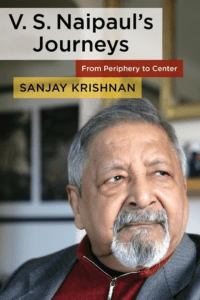
John spoke in 2020 with Sanjay Krishnan, Boston University English professor and Conrad scholar. The topic? His marvelous new book about that grumpiest of Nobel laureates, V. S Naipaul’s Journeys. Krishnan sees the “Contrarian and unsentimental” Trinidad-born but globe-trotting novelist and essayist as early and brilliant at noticing the unevenness with which the blessings and curses of modernity were distributed in the era of decolonization. Centrally, Naipaul realized and reckoned with the always complex and messy question of the minority within postcolonial societies.
Continue reading “115* Sanjay Krishnan on V. S. Naipaul: To make the Deformation the Formation (JP)”114 John Guillory Professes Criticism (JP, Nick Dames)
John Guillory (NYU English author of the pathbreaking Cultural Capital) visits RTB to discuss Professing Criticism: Essays on the Organization of Literary Study (2022, Chicago).

He speaks with John and with Nick Dames, co-editor of Public Books, Professor of Humanities at Columbia and most recently author of The Chapter: A Segmented History from Antiquity to the Twenty-First Century (Princeton 2023). The gap between criticism and scholarship looms large, as does the utility of Panofsky‘s 1940 distinction between “monuments” and “documents.” they ask what sorts of cultural documents achieve aesthetic memorability, for good or for ill.
Continue reading “114 John Guillory Professes Criticism (JP, Nick Dames)”113* David Cunningham, January 6th and Asymmetrical Policing (JP, EF)
Recall This Book first heard from the sociologist of American racism David Cunningham in Episode 36 Policing and White Power. Less than a week after the horrors of January 6th, 2021, he came back for this conversation about “asymmetrical policing” of the political right and left–and of White and Black Americans. His very first book (There’s Something Happening Here, 2004) studied the contrast between the FBI’s work in the 1960’s to wipe out left-wing and Black protests and its efforts to control and tame right-wing and white supremacist movements. That gives him a valuable perspective on the run-up to January 6th–and what may happen next.
Continue reading “113* David Cunningham, January 6th and Asymmetrical Policing (JP, EF)”111* Samuel R Delany, Nevèrÿon and beyond (JP)
.
John Plotz talked with Samuel Delany, living legend of science fiction and fantasy back in 2019. You probably know him best for breakthrough novels like Dhalgren and Trouble on Triton, which went beyond “New Wave” SF to introduce an intense and utterly idiosyncratic form of theory-rich and avant-garde stylistics to the genre. Reading him means leaving Earth, but also returning to the heady days when Greenwich Village was as caught up in the arrival of Levi-Strauss and Derrida to America as it was in a gender and sexuality revolution.

RTB loves him especially for his mind-bending Neveryon series: did you know that many consider his 1984 novella from that series, “The Tale of Plagues and Carnivals,” (set both inside the world of Neveryon and along Bleecker Street in NY) the first piece of fiction about AIDS in America?
Continue reading “111* Samuel R Delany, Nevèrÿon and beyond (JP)”110* Novel Dialogue: Joshua Cohen (JP, Eugene Sheppard)
In this episode (originally aired by our partner Novel Dialogue) John and his Brandeis colleague Eugene Sheppard speak with Joshua Cohen about The Netanyahus. Is the 2021 novel a Pulitzer-winning bravura story of the world’s worst job interview? Or is it a searing indictment of ethno-nationalist Zionism–and the strange act of pretense whereby American Jewish writers and thinkers in postwar America pretended that Israel and its more extreme ethno-nationalist strains didn’t concern them?

Cohen dramatizes the return of that repressed by imagining the family of the Benzion Netanyahu (actual medieval Spanish historian and father of Israel’s past and present Prime Minister Bibi) landing itself on a would-be assimilated American Jewish family ripped straight from the pages of a Philip Roth or Bernard Malamud novel.
Continue reading “110* Novel Dialogue: Joshua Cohen (JP, Eugene Sheppard)”109* Recall This Buck with Thomas Piketty (JP, Adaner)
Is Thomas Piketty the world’s most famous economic historian ? A superstar enemy of plutocratic capitalism who wrote a pathbreaking bestseller, Capital in the 21st Century? Or simply a debonair and generous French intellectual happy to talk redistributive justice? Join this 2020 conversation with John and Adaner Usmani (star of RTB’s episode 44: Racism as idea, Racism as Power Relation) to find out.

108* Desan on Making Money (Recall This Buck )
Our Recall this Buck series, back in 2020 and 2021, explored the history of money, ranging from the earliest forms of labor IOUs to the modern world of bitcoin and electronically distributed value. We began by focusing on the rise of capitalism, the Bank of England, and how an explosion of liquidity changed everything.

We were lucky to do so, just before the Pandemic struck, with Christine Desan of Harvard Law School, who recently published Making Money: Coin, Currency, and the Coming of Capitalism (Oxford University Press, 2014). She is also managing editor of JustMoney.org, a website that explores money as a critical site of governance. Desan’s research explores money as a legal and political project. Her approach opens economic orthodoxy to question by widening the focus on money as an instrument, to examine the institutions and agreements through which resources are mobilized and tracked, by means of money. In doing so, she shows that particular forms of money, and the markets within which they circulate, are neither natural or inevitable.
Continue reading “108* Desan on Making Money (Recall This Buck )” Recall This Book